
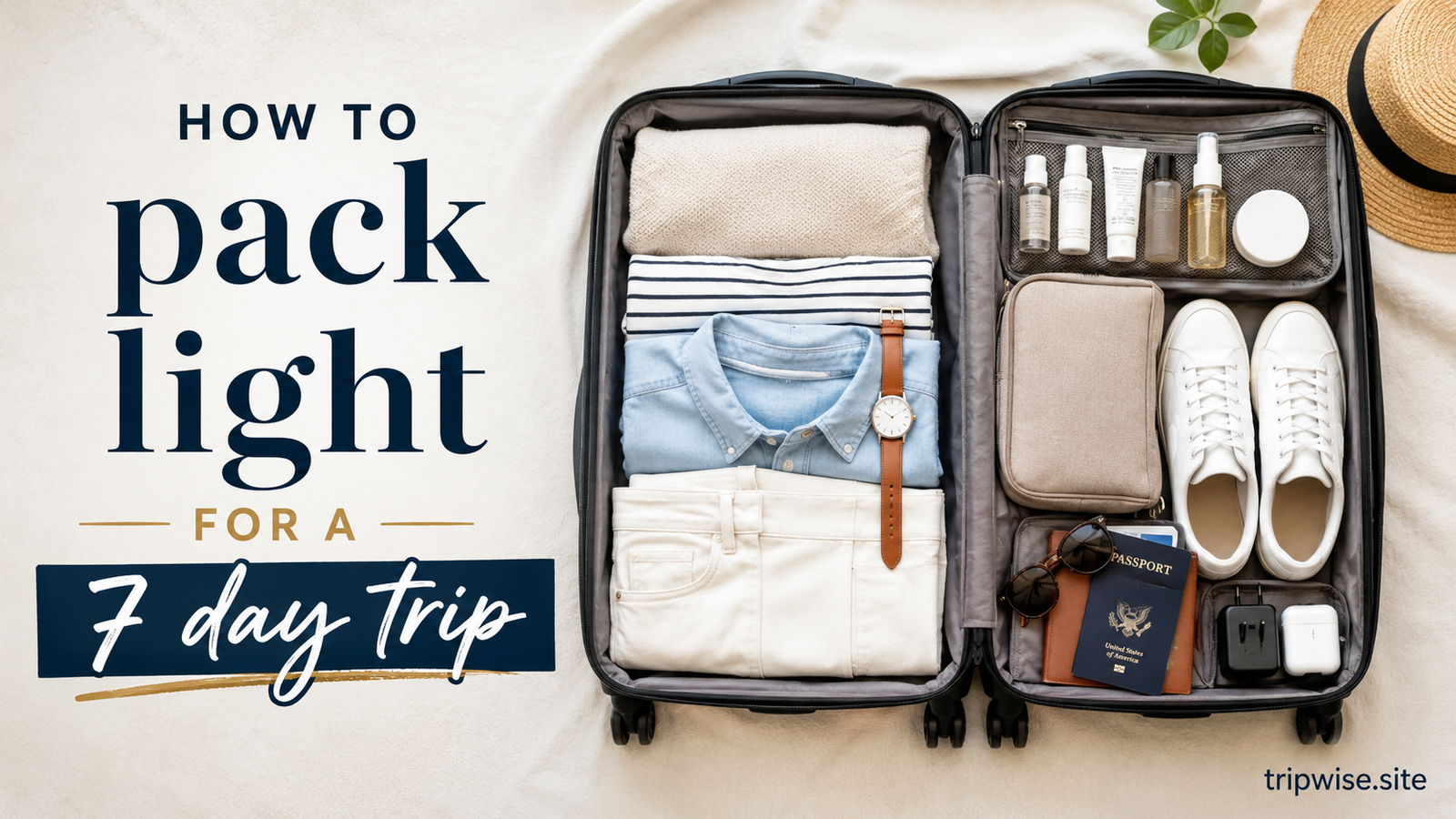

Packing for a week does not require a large checked suitcase. With a small capsule wardrobe, a realistic itinerary, and a strict limit on “just in case” items, most travellers can fit everything they need into a carry-on.
If you are wondering how to pack light for a 7 day trip, the goal is not to take the fewest possible items. It is to pack a small group of useful items that work together, suit the weather, and cover the activities you have actually planned. This guide gives you a practical system, a complete checklist, and simple ways to reduce weight without sacrificing comfort.
The Quick Answer: What Should You Pack for Seven Days?
For a typical seven-day trip, start with five tops, three bottoms, two pairs of shoes in total, one light outer layer, one set of sleepwear, underwear, socks, compact toiletries, essential medication, and one small electronics pouch. Wear your heaviest clothes and bulkiest shoes while travelling.
This is a starting point, not a universal rule. A beach holiday, winter city break, hiking trip, and business conference require different clothing. Always adjust the list for your destination, expected weather, accommodation, and planned activities.
Why Packing Light Is Worth It
Travelling with less makes the entire journey easier. You can move through airports and stations faster, use stairs and public transport more comfortably, and spend less time waiting at baggage claim. A smaller bag is also easier to keep organized because every item has a clear purpose.
Packing light can also help you avoid checked-baggage fees, but this depends on your airline and fare. Some tickets charge separately for cabin bags or enforce strict weight limits. Check the current size and weight allowance on your airline’s official website before choosing your luggage.
1. Start With the Trip, Not the Packing List
The biggest packing mistake is choosing clothes before checking what the trip actually involves. Review these four things first:
- Weather: Check the forecast, temperature range, rain probability, and evening conditions.
- Activities: List confirmed plans such as walking tours, dinners, meetings, swimming, hiking, or religious-site visits.
- Dress requirements: Note any formal events, cultural expectations, or venue-specific dress codes.
- Laundry access: Check whether your accommodation has a washing machine, laundry service, or a nearby laundromat.
Plan for the most likely conditions rather than every possible emergency. One lightweight rain layer is sensible when showers are possible; a heavy coat for a warm destination is not.
2. Choose the Right Carry-On
Use the smallest bag that fits your genuine needs and meets your airline’s allowance. A backpack is useful for stairs, uneven streets, and multi-city trips. A small rolling suitcase is easier to move through airports and keeps structured clothing neater.
The bag itself should be lightweight. A heavy empty suitcase uses part of your allowance before you pack anything. Useful features include comfortable handles or straps, durable zips, a simple internal layout, and an external pocket for documents or items needed in transit.
Avoid choosing an expandable bag as an excuse to pack more. An expanded suitcase may no longer meet the airline’s permitted dimensions.
3. Build a Seven-Day Capsule Wardrobe
A capsule wardrobe is a small collection of clothes that can be combined into multiple outfits. It is the most reliable way to pack light for a week.
Choose one neutral base, such as black, navy, beige, grey, or denim. Add one or two colours that work with that base. Every top should match at least two bottoms, and your shoes should work with nearly every outfit.
A practical clothing formula
For a general leisure trip, use this formula:
- 5 tops
- 3 bottoms
- 2 pairs of shoes in total
- 1 light jacket, cardigan, overshirt, or sweater
- 1 set of sleepwear
- 7 pairs of underwear
- 5 to 7 pairs of socks, depending on footwear
- 1 optional swimsuit
- 1 optional activity-specific or smarter outfit
One top, one bottom, the outer layer, and the bulkiest shoes can be worn during travel. That means fewer large items need to go inside the bag.
Five tops and three bottoms can create several combinations without requiring seven completely separate outfits. Choose quick-drying, lightweight fabrics where practical. Avoid packing delicate items that need special ironing, washing, or matching accessories unless the itinerary requires them.
Limit shoes to two pairs
Shoes consume more space than almost anything else in a carry-on. For most trips, take:
- One comfortable walking pair, worn in transit
- One lightweight pair suited to your destination, such as sandals, flats, loafers, or compact trainers
Do not pack hiking boots, formal shoes, gym shoes, sandals, and casual trainers “just in case.” Take specialized footwear only when a confirmed activity requires it.
4. Pack Smaller Toiletries
Do not carry a full bottle when you need only a small amount for one week. Transfer shampoo, conditioner, cleanser, lotion, and other products into leakproof travel containers. Better still, use solid versions of suitable products when they work for you.
A simple toiletry kit may include:
- Toothbrush and travel-size toothpaste
- Deodorant
- Shampoo and conditioner
- Face cleanser and moisturizer
- Sunscreen
- Razor or grooming essentials
- Minimal makeup, if needed
- Prescription medication
- A few basic first-aid items
Avoid packing products supplied by your accommodation unless you require a specific formula.
For flights departing from the United States, the TSA liquids rule generally limits carry-on liquids, gels, creams, aerosols, and pastes to containers of 3.4 ounces or 100 millilitres, all fitting inside one quart-size bag. Rules and screening procedures can differ by country and airport, so check the official guidance for every airport on your route.
Keep essential medication in your personal item rather than deep inside your main bag. Carry it in its original labelled packaging when required, and check destination-specific medicine restrictions before travelling internationally.
5. Reduce Electronics and Cables
Technology becomes heavy when each device has its own charger and accessory. Take only the equipment you expect to use.
For many travellers, the essentials are:
- Phone
- Compact charger
- One charging cable
- Power bank
- Travel adapter for international trips
- Earbuds or headphones
Take a laptop, tablet, camera, smartwatch charger, or second power bank only when the trip genuinely requires it. Where devices support the same charging standard, one multi-port charger can replace several plugs. Make sure your power bank complies with your airline’s current cabin-baggage rules.
Download boarding passes, maps, booking confirmations, and entertainment before leaving home. Keep important travel documents available offline in case you lose mobile data.
6. Use a Packing Method That Saves Space
Packing technique matters, but it cannot fix an oversized packing list. Remove unnecessary items before trying to compress everything.
Roll soft items and fold structured clothes
Roll T-shirts, casual tops, underwear, and other soft items. Fold trousers, shirts, blazers, or easily creased garments along their natural seams. The best method is usually a combination of rolling and folding rather than one technique for everything.
Use packing cubes for organization
Packing cubes make it easier to separate tops, bottoms, underwear, and laundry. Compression cubes can reduce bulk, but they do not reduce weight. Check the bag on a scale after packing instead of assuming that a compact bag is a light bag.
Use empty spaces
Put socks, belts, or small accessories inside packed shoes. Place shoes heel-to-toe in a shoe bag near the base of the suitcase. Fill narrow gaps with soft items, but do not add unnecessary objects simply because space remains.
Keep transit essentials accessible
Your passport, wallet, medication, phone, charger, liquids bag, and one clean top should be easy to reach. Do not bury anything you may need at security or during the journey.
Complete 7 Day Trip Packing List
Use this checklist as a base and remove anything that does not match your itinerary.
Travel documents and money
- Passport or required identification
- Visas or entry documents
- Boarding passes and booking confirmations
- Travel insurance details
- Bank cards and a small amount of local cash
- Emergency contact information
- Copies of important documents stored securely
Clothing
- 5 versatile tops
- 3 bottoms
- 1 light outer layer
- 1 set of sleepwear
- 7 pairs of underwear
- 5 to 7 pairs of socks
- 2 pairs of shoes in total
- 1 swimsuit, if required
- 1 compact smarter outfit, if required
- Weather-specific accessories such as a hat, scarf, or gloves
Toiletries and health
- Toothbrush and toothpaste
- Deodorant
- Small shampoo and conditioner
- Face and skin-care essentials
- Sunscreen
- Razor or grooming items
- Prescription medication
- Basic pain relief and personal health items
- Small laundry bag or reusable dry bag
Electronics
- Phone
- Charger and cable
- Power bank
- Travel adapter
- Earbuds or headphones
- Only the work or camera equipment the trip requires
Useful extras
- Refillable water bottle
- Sunglasses
- Compact umbrella or packable rain layer
- Small snack
- Reusable shopping bag
- Pen
Step-by-Step: How to Fit Everything in One Carry-On
- Check the airline allowance. Confirm cabin-bag size and weight limits for your exact fare.
- Check the forecast and itinerary. Pack for real plans and likely conditions.
- Lay everything out. Seeing the full list makes duplicates and unnecessary items easier to spot.
- Build complete outfits. Remove anything that does not match at least two other clothing items, unless it serves a specific purpose.
- Wear the bulkiest items. Travel in your larger shoes, heaviest bottom, and outer layer.
- Pack shoes first. Place them near the wheels or bottom of the bag to create a stable base.
- Add clothing in cubes. Roll soft items, fold structured pieces, and avoid overcompressing.
- Add toiletries and electronics. Keep liquids and security-screening items accessible.
- Leave a little free space. A tightly overfilled bag is difficult to repack and leaves no room for a small purchase.
- Weigh the finished bag. Remove low-priority items if it exceeds the airline’s limit.
Common Overpacking Mistakes
Packing seven separate outfits
You need enough combinations for seven days, not seven unrelated looks. A coordinated capsule wardrobe gives you more flexibility with fewer pieces.
Packing for unlikely emergencies
Extra shoes, multiple jackets, and duplicate toiletries add weight quickly. Pack for probable needs. Most common low-cost items can be purchased at the destination if necessary.
Taking too many “small” items
Accessories, cables, cosmetics, books, and travel gadgets appear harmless individually. Together, they can occupy an entire section of your bag. Review them as one category and keep only the essentials.
Using compression to hide overpacking
Compression bags can make bulky clothing smaller, but the weight stays the same. They may also encourage you to exceed the airline limit.
Ignoring the return journey
Dirty laundry is harder to compress neatly, and purchases require space. Pack a small laundry bag and leave some capacity for the return trip.
How to Adjust the List for Different Trips
Warm-weather or beach trip
Choose breathable tops, lightweight bottoms, one swimsuit, sandals, and a packable sun hat. You may need fewer socks and no heavy outer layer, but sunscreen and sun protection become more important.
Cold-weather trip
Wear your coat and boots during transit. Pack thin thermal base layers instead of several bulky sweaters. Two bottoms, a mid-layer, warm socks, gloves, and a compact hat can be more efficient than multiple heavy outfits.
Business trip
Use one coordinated colour palette. Pack two bottoms, three work tops, one blazer or structured layer, and one pair of professional shoes. Wear the blazer and larger shoes while travelling. Confirm whether the hotel provides an iron or steamer.
Active or hiking trip
Prioritize safety and suitable equipment over minimalism. Pack activity-specific footwear, quick-drying clothing, weather protection, and required safety gear. Reduce casual clothing instead of removing essential outdoor equipment.
Frequently Asked Questions
Is a carry-on enough for a 7 day trip?
For many city, beach, business, and general leisure trips, a carry-on is enough for seven days. Success depends on the climate, planned activities, airline weight limit, and whether you can rewear or wash clothes. Trips requiring bulky winter gear or specialized equipment may need more space.
How many outfits should I pack for seven days?
Pack versatile separates rather than seven fixed outfits. Five tops and three bottoms can cover a week when the colours and styles work together. Add one specialized outfit only if a planned event requires it.
How many pairs of shoes should I take?
Two pairs in total are enough for most trips. Wear the heavier walking pair and pack one lightweight alternative. A third pair should be added only for a specific activity or formal requirement.
Is it better to roll or fold clothes?
Roll soft, casual garments and fold structured or wrinkle-prone clothing. A mixed method usually uses space more effectively and protects clothes better than rolling everything.
Do packing cubes actually save space?
Packing cubes mainly improve organization. Compression cubes can reduce the volume of soft clothing, but neither type reduces the bag’s weight. They are useful only after you have removed unnecessary items.
Should I plan to do laundry during a one-week trip?
Laundry is optional for a seven-day trip, but one quick wash can reduce the number of tops, socks, and undergarments you need. Check your accommodation’s facilities before relying on this strategy.
Final Thoughts
Learning how to pack light for a 7 day trip comes down to three decisions: take a bag that matches the airline limit, build a small wardrobe around your real itinerary, and remove items packed only for unlikely situations.
Start with five tops, three bottoms, two pairs of shoes, one outer layer, and compact essentials. Wear your bulkiest items, keep important documents and medication accessible, and weigh the bag before leaving. You will arrive with what you need—and without carrying a week’s worth of unnecessary luggage.
Explore more practical planning guides in the Travelling Tips section on Tripwise.